

When Your Cornea Changes Shape

What Is Keratoconus?
Your cornea is supposed to be dome-shaped, like a basketball. With keratoconus, it gradually thins and bulges outward into a cone shape, more like a football.
This irregular shape distorts how light enters your eye, causing vision problems that regular glasses can’t fully correct. The name literally means “cone-shaped cornea.”
How Common Is It?
More common than you might think. It affects about 1 in 2,000 people, usually starts in teens or early 20s, progresses through 30s-40s then typically stabilizes, and affects both eyes but often asymmetrically.
What Causes It?
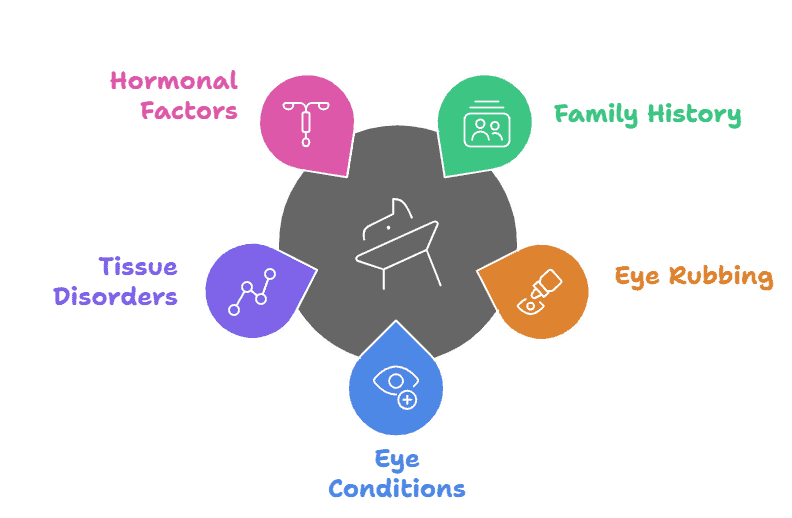
Honestly? We don’t fully know. It’s likely a combination of several factors:
Genetics: Runs in families; 10-20% of people with keratoconus have an affected family member.
Eye rubbing: There’s a strong correlation with chronic, vigorous eye rubbing.
Allergies: Especially when they lead to excessive eye rubbing.
Connective tissue disorders: Including Down syndrome, Ehlers-Danlos syndrome, and Marfan syndrome.
UV exposure: May play a role, though research is still ongoing.
What Are the Symptoms?
Early on, symptoms are subtle: slightly blurred vision, mild astigmatism that keeps changing, increased light sensitivity, and glare and halos around lights.
As it progresses: significant vision distortion, frequent prescription changes, glasses don’t help much anymore, one eye might be worse than the other, and difficulty with night driving.
Advanced cases: Severe distortion, clouding of the cornea, and the eye becomes more sensitive and irritated.
How Is It Diagnosed by Your Eye Doctor?
Comprehensive Eye Exam: Looking for irregular astigmatism, thinning cornea, and characteristic cone shape.
Corneal Topography: This is the key test. It maps your cornea’s shape with thousands of measurements and creates a color-coded “map” showing irregularities. Think of it like a topographical map showing mountains and valleys.
Pachymetry: Measures corneal thickness (keratoconus causes thinning).
Slit Lamp Exam: Shows stress lines and scarring in advanced cases.
Will I Go Blind?
No, keratoconus rarely causes blindness. But it can significantly impact your quality of life without treatment from your eye doctor.
The goal is to give you functional vision, stop progression (if actively worsening), and avoid or delay corneal transplant.
How Is Keratoconus Treated?
Treatment depends on severity:
MILD KERATOCONUS:
- Glasses or soft contact lenses may still work adequately
- Monitoring with regular exams from your eye doctor (every 6-12 months)
MODERATE KERATOCONUS:
- Rigid gas permeable (RGP) contact lenses: The gold standard. Create a smooth, regular front surface, vault over the irregular cornea, provide excellent vision, but take some time to adapt to.
- Hybrid lenses: RGP center with soft lens skirt. Easier to adapt to than RGPs with good vision and more comfort.
- Scleral lenses: Large rigid lenses that vault over the entire cornea, rest on white part of the eye (sclera), create fluid reservoirs, are extremely comfortable, provide excellent vision, and are often the best option for moderate-advanced keratoconus.
PROGRESSIVE KERATOCONUS:
Corneal Cross-Linking (CXL): The game-changer. Strengthens corneal tissue to stop progression, uses riboflavin drops plus UV light, outpatient procedure (about 60-90 minutes), can prevent need for transplant, and is most effective in younger patients with progressive disease.
ADVANCED KERATOCONUS:
- Intacs (Corneal Rings): Tiny plastic inserts placed in cornea to help flatten the cone, can improve vision and contact lens fit, and is a reversible procedure.
- Corneal Transplant (PKP or DALK): Last resort with excellent success rates, but recovery takes months and glasses or contacts are usually still needed after.
What Are Scleral Lenses and Why Are They So Great?
Scleral lenses are the revolution in keratoconus treatment. They have a large diameter (larger than your iris), vault completely over cornea without touching it, rest on sclera (white part), and create fluid-filled space between lens and cornea.
Benefits: Incredibly comfortable (don’t feel them once they’re in), excellent stable vision, can be worn all day, good for severe dry eye too, and less likely to pop out.
The catch: Require proper fitting (several appointments with your eye doctor), insertion technique takes practice, more expensive than regular contacts, and need special training to fit (not all eye doctors do this). We specialize in scleral lens fittings, it’s one of our areas of expertise.
What's Cross-Linking and Should I Get It?
Corneal cross-linking (CXL) is the only treatment that stops progression.
You’re a candidate if your keratoconus is actively progressing, you’re typically under 40 (older patients tend to have stable disease), cornea is thick enough for the procedure, and you have no significant scarring yet.
What happens: Numbing drops applied, epithelium (top layer) removed or kept on (depends on protocol), riboflavin drops applied for 30 minutes, cornea exposed to UV light for 10-30 minutes, and protective contact lens placed.
Recovery: First few days bring discomfort and light sensitivity. First week, vision may be worse than before. Next 3-6 months, vision gradually improves. Full effect takes 6-12 months.
Important: CXL doesn’t improve vision, it stops worsening. You’ll still need contacts or glasses.
Does Insurance Cover This?
Vision insurance typically covers: Diagnostic testing and standard contact lens fittings.
May not fully cover: Scleral lens fittings (specialty fitting), the lenses themselves (often cost $1,000-2,500 per eye), or cross-linking (check medical insurance, many cover if progressive).
We’ll work with your insurance and discuss payment options
Can Children Get Keratoconus?
Yes, and it tends to progress faster in children and teens. Watch for frequent prescription changes, squinting or tilting head, complaints about vision even with new glasses, and eye rubbing (especially if they have allergies).
If your child has keratoconus: Consider cross-linking early to stop progression, be vigilant about preventing eye rubbing, and ensure regular monitoring with your eye doctor is crucial.
What About Eye Rubbing?
Stop rubbing your eyes. Seriously.
Eye rubbing is strongly linked to keratoconus progression. Every time you rub, you put mechanical stress on the cornea, potentially weaken the tissue, and may speed up the thinning process.
If you have allergies causing eye rubbing: Use allergy eye drops, take oral antihistamines, keep artificial tears handy, and consider allergy immunotherapy.
Break the habit: When you feel the urge, use cold compresses or preservative-free drops instead.
Will I Need a Corneal Transplant?
Most people don’t, especially with modern treatments like cross-linking and scleral lenses from your eye doctor.
Transplant is considered when: Contact lenses can’t provide functional vision, cornea has significant scarring, corneal thinning is too severe, or all other options are exhausted.
Good news: Corneal transplant has a 95% success rate and can restore vision.
How Often Should I Be Monitored?
- Mild, stable disease: Yearly
- Progressive disease: Every 3-6 months
- After cross-linking: More frequently initially, then annually
- New scleral lens wearer: Several follow-ups in first few months
Regular monitoring with your eye doctor is essential, we need to catch progression early.
Living with Keratoconus
The good news: With proper management from your eye doctor, most people with keratoconus maintain good functional vision throughout their lives.
Keys to success: Stop eye rubbing, manage allergies aggressively, wear contact lenses as prescribed, keep all follow-up appointments, consider cross-linking if progressive, and protect eyes from UV with sunglasses.
Remember: Keratoconus is manageable. We have more tools than ever to preserve your vision and quality of life.
Concerned about keratoconus? We specialize in advanced contact lens fittings, including scleral lenses. Schedule a comprehensive corneal evaluation and discover your best vision options.