
The Back-to-School Essential Many Parents Are Skipping
Every fall, parents rush through the back-to-school checklist. New shoes, new backpack, new notebooks. But there is one item that research consistently shows parents understand is important and still regularly skip: the eye exam.
More than 80% of classroom learning is visual. A child who cannot see the board clearly will not raise their hand and say so. They will just struggle. The video below, featuring an optometrist breaking down exactly what vision problems look like in real children, is worth watching before the school year starts.
Why vision problems are so easy to miss
Most children with significant vision problems do not complain about their eyesight. They have never experienced clear vision, so they assume the blur they see is what everyone sees. They adapt. They sit closer to the board, avoid reading when they can, or simply stop paying attention in class because the content on the board is illegible.
By the time a parent or teacher notices something is wrong, the child has often spent months working around a vision problem that a 45-minute eye exam could have identified and corrected.
School vision screenings catch some of these cases, but not most of them. They test distance vision only and miss farsightedness, focusing difficulty, eye coordination problems, and early myopia. A child can pass a school screening in September and still need glasses.
The red flags parents and teachers often miss
Children rarely say they cannot see the board. What they say and do instead tends to look like a behavioral or attention problem rather than a vision problem. Here are the signs that an eye exam is overdue:
- Sitting unusually close to the TV or holding books very close to their face
- Frequent headaches, especially after reading or screen time
- Rubbing their eyes or blinking excessively during close-up tasks
- Losing their place while reading, or using a finger to track each line
- Squinting, tilting their head to one side, or covering one eye to see better
- Avoiding reading, homework, or any close-up activity they used to enjoy
- Struggling academically despite genuine effort, particularly with reading
- One eye that appears to drift, cross, or turn outward
Any one of these warrants a call to an eye doctor. Several together almost certainly mean a child needs a comprehensive eye exam right away.
What myopia is and why it matters more now than it did for previous generations
Myopia, commonly called nearsightedness, is the most common vision problem in school-age children and it is getting more common. Children with myopia can see clearly up close but struggle to focus on distant objects like a classroom board, a scoreboard, or a face across a room.
Beyond the immediate challenge of blurry distance vision, myopia that is not managed can worsen progressively throughout childhood. Each year without correction or treatment is a year of additional progression. High myopia in adulthood is linked to an increased risk of serious eye conditions including retinal detachment, glaucoma, and macular degeneration.
The good news is that myopia management options have advanced significantly. Depending on a child’s age and prescription, options may include specialty contact lenses, low-dose atropine eye drops, and orthokeratology lenses worn overnight. An eye doctor can determine which approach makes sense and begin slowing the rate of progression.
The difference between a school screening and a comprehensive eye exam
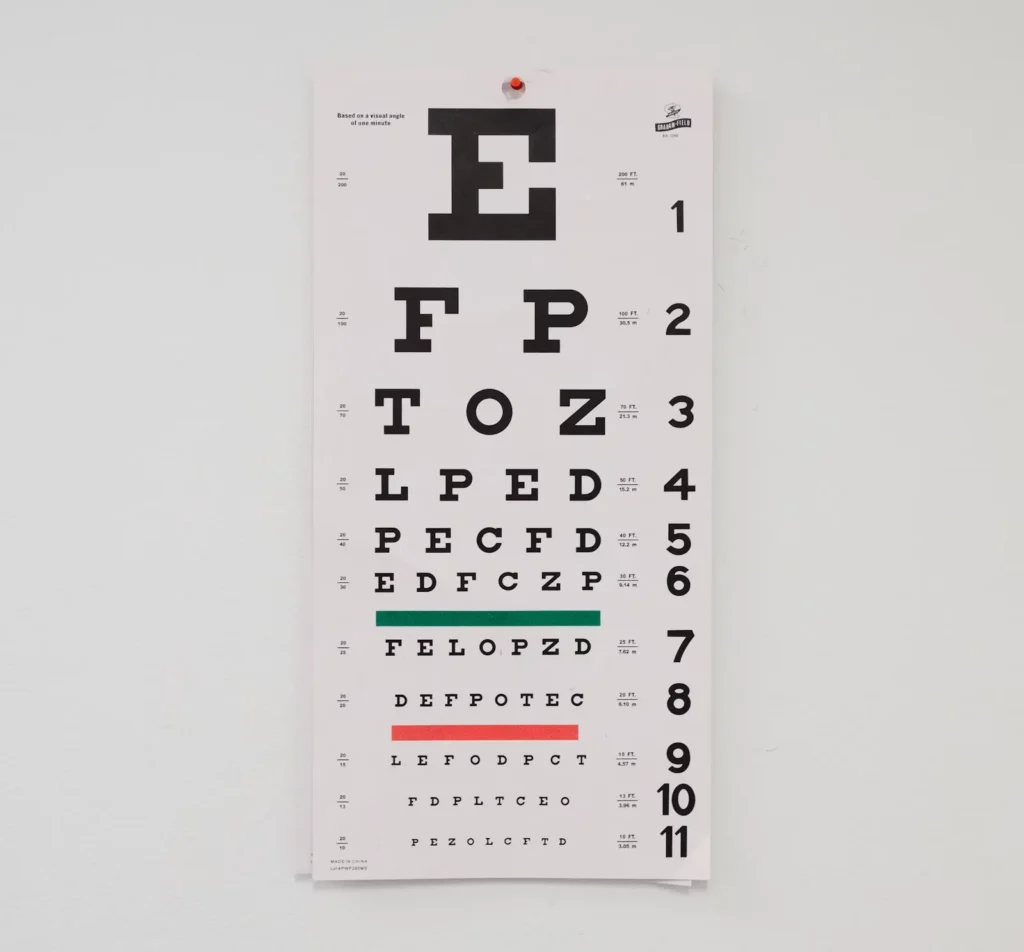
A school vision screening is a quick distance test, often administered by a nurse or health aide in a hallway. It checks whether a child can read letters on a chart from 20 feet away. That is all it checks.
A comprehensive pediatric eye exam at an optometry office tests near vision, eye coordination, focusing ability, tracking, depth perception, color vision, and the overall health of the eye itself. It takes 30 to 45 minutes and gives a complete picture of how a child’s visual system is actually working. Research confirms that up to 75% of significant children’s vision problems go undetected by standard school screenings.
When children should have their eyes examined
Most eye care organizations recommend the following schedule:
- First exam: around 6 to 12 months of age
- Second exam: between ages 3 and 5
- Third exam: before starting kindergarten
- Annual exams: every year through childhood and adolescence
The infant and preschool exams are the ones most commonly skipped. Parents often assume vision problems only become relevant once a child is in school and reading. In reality, some of the most treatable conditions, including amblyopia (lazy eye) and strabismus (eye misalignment), have treatment windows that close around age 7 to 9. Earlier detection means more options and better outcomes.
What to do if you think your child has a vision problem
Do not wait for the next school screening. Call and schedule a comprehensive eye exam directly. Most vision insurance plans cover one pediatric exam per year with a low or zero copay, and most offices offer same-day or next-day appointments.
If your child already wears glasses or contacts, the start of the school year is also a good time to confirm the prescription is current. Prescriptions can change significantly in a single school year in growing children, and an outdated prescription causes the same kinds of attention and performance struggles as an untreated problem.
Book your child’s eye exam at Master Eye
Master Eye sees children of all ages, from infants through teenagers, for comprehensive eye exams at all 9 offices across Central Texas. We use picture-based and play-based testing for children who are not yet reading, and we always go at the child’s pace.
Walk-ins are welcome and same-day appointments are often available. If you have been putting off your child’s eye exam, the start of the school year is the right time to schedule it.
Book your child’s eye exam at your nearest location:
- Round Rock: 512-246-3937
- Arbor Walk (Austin North): 512-345-7290
- Bee Cave: 512-263-0020
- Cedar Park: 512-257-7070
- Georgetown: 737-284-9595
- Kyle: 737-302-2751
- Mueller (Austin Central): 512-452-3227
- Southpark Meadows (Austin South): 512-291-0876
- Sunset Valley: 512-330-9513