Everything you need to bring and know before your visit.
Please bring and prepare the following before your appointment:
To help shorten your check-in time, please complete your patient forms prior to arriving:
Please bring the following items with you:
If you would like us to share your results with your primary care doctor, please have your primary care physician’s name and contact information available.
If you are scheduled for a comprehensive eye exam, please remove your contact lenses at least two hours before your appointment. This helps ensure accurate measurements and the most precise prescription.
We ask for both medical and vision insurance because different parts of your eye exam may be billed differently depending on what your doctor finds during your visit.
Vision insurance typically covers:
Medical insurance may apply if your doctor evaluates or diagnoses a medical eye condition during the exam.
In some cases, what begins as a routine exam may reveal signs of a medical concern that requires medical testing or treatment.
Examples of medical eye concerns include:
When a medical eye condition is present, billing through medical insurance may help reduce your out-of-pocket costs and ensures the correct testing and care can be provided.
Bringing both insurance cards helps us bill accurately and allows you to maximize your benefits.
During a comprehensive exam, it is important for your doctor to evaluate the health of your retina. Many serious eye conditions can develop without noticeable symptoms, and routine evaluation helps detect problems early.
We offer two options, and you may choose the one that works best for you.
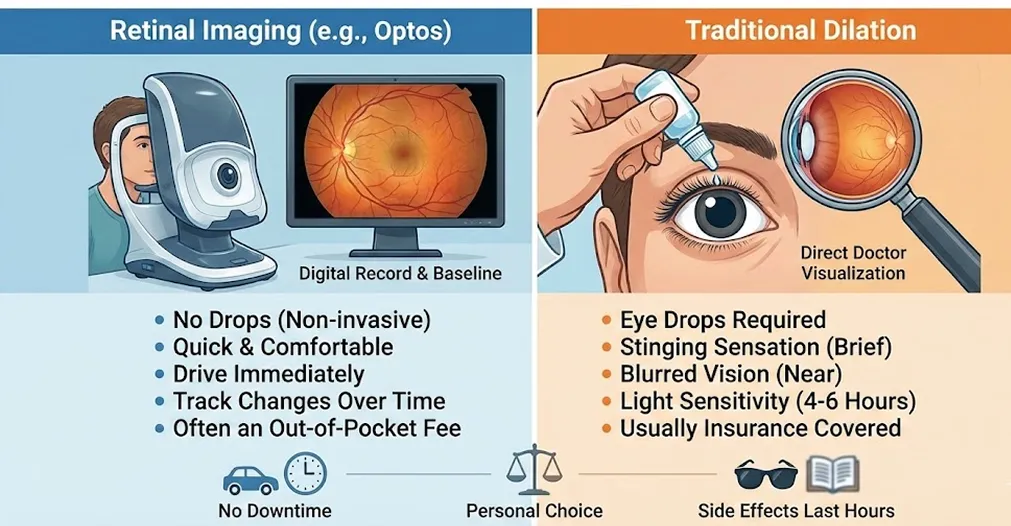
Our office offers SLO retinal imaging, an advanced scan that allows your doctor to evaluate retinal health in high detail without dilating your eyes.
Benefits of SLO retinal imaging:
Please note: SLO retinal imaging includes an additional fee.
Dilation involves placing drops in your eyes to widen the pupils so your doctor can examine the back of your eyes.
What to expect with dilation:
If you choose dilation instead of SLO retinal imaging, you must bring someone with you to drive you home.
Traditional dilation is effective, but SLO retinal imaging provides a more precise view of retinal health, provides better documentation for your medical record, and is a more comfortable experience for many patients especially those who need to drive or return to work afterward.
Contact Lenses
We do not sell contact lenses directly in-office, but we can order trial contact lenses when appropriate so you can try them before purchasing.
Purchasing Glasses or Contacts
We recommend using the glasses and contact lens distributor located next door to all of our locations. They often provide the best pricing and help patients maximize their insurance benefits.
This is especially helpful for patients with Vision Service Plan (VSP), as they can help you use your benefits most effectively.
If you have questions about what to bring, insurance, retinal imaging, or dilation, please contact our team before your visit. We are happy to help.
We look forward to seeing you.
We can still see you, but it may delay check-in or affect how your visit is billed. If possible, bring both medical and vision insurance cards to ensure accurate billing.
Bringing your current eyewear is helpful for the doctor to compare prescriptions and evaluate your vision needs. If you forget them, we can still proceed with the exam.
Contact lenses can temporarily change the shape of your eyes. Removing them helps ensure accurate measurements and the most precise prescription.
SLO retinal imaging is recommended because it provides highly detailed retinal images without blurring your vision. However, you may choose traditional dilation instead.
Most patients experience blurred vision and light sensitivity for several hours, depending on how their eyes respond to the drops. This is why we require a driver if you choose dilation.